

When revamping our spaces, there’s an integral, if not obvious, design element that is often overlooked: our interior doors. These not only act as gateways from room to room, but set up the visual identity of the entire space itself. Technically speaking, they’re the room’s first impression—and you know what they say about first impressions.
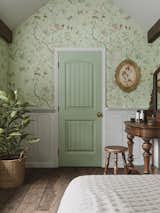
Masonite’s Cheyenne 2 Panel Door, shown here in a stunning pale olive shade, has a smooth finish that makes it ideal for craftsman and transitional home decor schemes.
Updating interior doors isn’t as turnkey as swapping in new rugs, pillows, or furniture, but it’s what we like to call a maximum-impact upgrade. Interior doors have just as much power in elevating the look, feel, and flow of our homes. While your interior doors certainly do not have to match each other or the front door, they do need to complement your architectural and personal style.
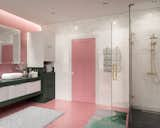
The Winslow 3 Panel Door, shown here in a cheerful coral hue, is a contemporary take on a classic. For an added touch of playfulness, take inspiration from this bathroom and match your door color with your tiles.
For example, if you have a contemporary color scheme and tons of bright wallpaper in a room, a traditional two-panel white door would look entirely out of place—not to mention date your home. Similarly, a classic, transitional-style room wouldn’t work well with a recessed, bright door. Even if you’re choosing a colorful door that makes a bold statement, it still needs to have a reference point. There are also factors to consider, such as the number of panels, whether they are raised or recessed, and the shape of the panels. Additionally, you should think about the door’s configuration in relation to your design goals. While the standard swing makes sense in most rooms, French doors are great for letting in more light; bifold doors are ideal for compact spaces; and barn doors serve as striking and flexible focal points.
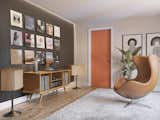
The Melrose 6 Panel Horizontal Door is brilliantly unique, making it perfect for a lover of all things mod. It has subtle panels with a smooth, sleek finish.
It isn’t just style that a new interior door can bring to a room, either: Well-appointed interior doors can add a sense of quiet and comfort, too. During the pandemic, our homes became practically everything to us: home gyms, office spaces, and calm oases from our busy lives. Unwanted noises—whether it’s your partner on a competing conference call or the whirring of the washer/dryer—can easily disrupt these multipurpose sanctuaries, often due to sounds passing through standard hollow core doors that lack effective sound dampening.
 Source link


